
|
|
by Tamra Reall (@MUExtBugNGarden) is a horticulture specialist for MU Extension – Urban West Region (Article used with permission from the Kansas City Gardener.) Get ready for a magical cicada spectacle this spring! Billions of buzzing insects from periodical cicada Broods XIII (13) and XIX (19) are emerging in April and May. Last seen together in 1803, they won't appear together again for another 221 years. In Missouri, we will just be seeing Brood XIX, while Brood XIII will be mostly in northern Illinois. I hope you will join the excitement, enjoy the rhythmic buzz, and marvel at nature’s spectacular show! What is the difference between periodical cicadas and the cicadas that come out every year? Periodical cicadas are like nature's timekeepers, following a mysterious, prime number schedule that scientists are still learning about. Having the longest life cycle in the insect world, periodical cicadas seem to magically appear together every 13 or 17 years. This is why their genus name is Magicicada! They spend most of their lives underground as nymphs feeding on the sap of tree roots. Then, as if waiting for the perfect moment, groups of Magicicada species, called a “brood,” emerge together all at once. These small, black cicadas with red eyes appear in such large numbers that they can cover trees. These clumsy fliers are easily captured by birds, squirrels, raccoons, and even dogs and cats. With so many emerging at the same time, many will survive to lay eggs for the next generation emerging in another 13 or 17 years later. Another fascinating feature of these insects is that the males sing together to attract females. In contrast, the large, green cicadas we see each summer have a shorter life cycle of 2-5 years and are known as annual or dog-day cicadas as some become adults every year. While these cicadas also sing in the trees, they give solo performances and do not synchronize like the periodical cicadas. Are periodical cicadas everywhere in the world? Although annual cicadas are found on every continent except Antarctica, periodical cicadas are only found in the eastern half of North America. Scientists do not know why they aren’t found anywhere else. There are four species of periodical cicadas in Brood XIX and these will emerge in Missouri, Indiana, Illinois, Kentucky, Maryland, Virginia, North Carolina, South Carolina, Arkansas, Oklahoma, Tennessee, Alabama, Georgia, Louisiana, and Mississippi. In Brood XIII, there are three species, and they are emerging in Illinois, Iowa, Indiana, Wisconsin, and possibly Michigan. Brood XIX, also known as the Great Southern Brood, emerges every 13 years, and Brood XIII (the Northern Illinois Brood) emerges every 17 years. 17-year broods tend to be in the northern states with cooler temperature zones, and 13-year broods tend to be in the warmer, southern states although there is a lot of overlap between 13- and 17-year broods. Why do cicadas shed their skin? Cicadas shed their skin to grow bigger. Like other insects, they have a hard outer covering called an exoskeleton. As they grow, their old exoskeleton becomes too small, so they shed it in a process called molting leaving behind old exuviae and growing new, larger exoskeletons. Do periodical cicadas hurt people, animals, or plants? Cicadas may land on people, but they won’t eat you – you don’t taste, feel, or smell right to them. That said, if one lands on you, gently brush it off, just in case the cicada is curious about what you might taste like! But, the cicadas can affect trees. Females lay their eggs in small twigs in trees. Large healthy trees aren’t harmed in the long term by this, although there may be dead twigs that fall after the cicadas are gone. Smaller trees can be damaged or even killed if not protected. Consider covering small, or newly planted, trees with a fine mesh material or cheesecloth to protect them during the 4-6 weeks the cicadas are out. Why do they make that loud sound? Males use a drum-like structure on their abdomen called tymbals to sing their loud, repetitive buzzing song, attracting female companions. A female will fly to the males and respond by quickly flicking her wings together if she likes his song. Periodical cicadas can be tricked by other vibrating sounds. They may be attracted to people mowing their lawns or using power tools. Periodical cicadas are loud! Because the males sing together, the buzzing sound can reach up to 100 decibels, which is as loud as a hair dryer, lawn mower, or a motorcycle. Consider wearing hearing protection if you will be outside for more than 15 minutes when the cicadas are singing to protect your hearing. What happens to cicadas after they mate and lay eggs? After mating, female cicadas lay their eggs in the branches of trees. They use a sharp ovipositor to make tiny slits in the bark, where they deposit their eggs. Males die soon after mating and females die after laying their eggs. A couple of weeks later, the eggs hatch and young cicada nymphs fall to the ground and burrow into the soil where they'll spend the next 13 or 17 years before starting the cycle all over again! ~~~~ Did you know that there is a Kids Ask Dr. Bug video series? Check it out! https://bit.ly/KADBvideos Do you have questions for Dr. Bug? Send them to https://bit.ly/KidsAskDrBug To help me learn what you learn from this column, or to share feedback, please consider filling out this survey: https://bit.ly/KidsAskDrBugSurvey  Known for their red eyes, cicada eyes actually can be several colors. Photo courtesy of Gene Kritsky, Mount St. Joseph University  by Cole Arndorfer The Board of Education met on Thursday, February 22nd for its February business meeting. The board recognized three groups, took action on two items of new business and heard two more, and discussed an update to board policies. First, the board recognized the Sni-A-Bar STEM club. This club received third place in the Burns & McDonnell STEM Battle of the Brains competition and was awarded a $20,000 grant to be used on STEM materials. Next, the board honored four present members of the MMEA All-State Children’s Honor Choir that was held on January 24. For their final recognition, the board honored two present members of the High School All-State Band. After the three group recognitions, Grain Valley South Middle School principal, Jim Myers, along with staff and students, took time to recognize the school board ahead of School Board Recognition Month in March. Eighth grade students passed out origami eagles, thank you notes, cookies, showed off a thank you painting made in an art class, as well as a thank you video put together by students and staff. Following the recognitions, Superintendent Dr. Brad Welle gave his monthly report. Welle first talked about the tax levy campaign by the district. The district has put information regarding the ballot measure, as well as frequently asked questions on their website as well as on YouTube. Welle also said that construction is still on track at the high school. The new weight room is still on track to be ready by April, with the rest of the construction slated to be completed by the first day of school next fall. Next, the board moved into new business. The first item under this was amendments to the 2023-24 budget. Dr. Welle said these amendments account for different grants that the district received that affect its income and expenditures. This item was passed. The next item of new business was the approval of three new certified full-time positions for next school year. While this is a bit earlier than normal, Welle said that the reason to bring these positions up now is to gain a competitive edge on other school districts in the hiring process. This item was also passed. Following the approval of three certified full-time positions, the board discussed next school year’s pay schedules. Assistant Superintendent Dr. Nick Gooch said that the new pay schedules drafted are based on if the levy passes and they would ensure that each district employee will receive a raise. For the final item of new business, the board discussed the board scholarship for the year. Dr. Julie Taylor, Eddie Saffell, and Sarah Swartz volunteered to review the record 48 student applications. Next, the board moved onto board policies where they discussed updates to a set of policies. Many of the updates are related to new laws regarding marijuana set forth by the state. Welle explained updates ensure the language of the policies make clear that just because marijuana is legal, it is not okay for students or faculty to come to school under the influence. The only other update would be changing language in student discipline policies to include the use of A.I. under academic dishonesty. The board then adjourned into executive session. The next school board meeting will be held at 6:00pm on March 14th in the Leadership Center. For those interested in learning more about the upcoming levy ballot measure in Grain Valley, Grain Valley Schools will host two Community Presentations next week: Grain Valley South Middle School - Tuesday, February 20th at 6:00pm Grain Valley North Middle School - Wednesday, February 21st at 6:00pm The district is also offering a member of the superintendent's team to serve as a guest speaker on the levy ballot measure to neighborhood or community organizations. To request a guest speaker, complete the following form: Levy Ballot Measure (google.com) Grain Valley senior Chance Marler's silver medal was awarded on a Tuesday afternoon, just a few hours after he competed in the SkillsUSA West Central District contest for Automotive Service Technology. But the training that saw him through to victory has been over a year and a half in the making. "It started with Automotive Technology I my junior year," Chance shares. "That's where I really learned the mechanical tasks I had to perform. Using what I learned my junior year to work over the summer for US Lawns on their fleet trucks and professional lawn mowers helped, too." The competition contained multiple parts, from a 100-question exam with a focus on diagnostic and repair content to customer service and job interview assessments. Grain Valley senior Jordyn Harris took third place in Automotive Service Technology, with another CTC student, Diego Gonzalez Aguilar of Blue Springs, taking first. "SkillsUSA is an outstanding organization," says Chance and Jordyn's CTC Automotive Technology instructor Bill Lieb. "Students get to compete in the areas they train in, whether it be automotive, CPR, or customer service. But they also get to see how everything they're doing at their home high schools, the math, the English, the public speaking, how it all matters." It's an organization that graduates appreciate long after they leave, even going so far as to encourage other students to get involved. "It was actually two other Grain Valley students, Carson (Davis) and Tanner (Todd), who did Automotive last year and went to State, that got me into SkillsUSA," Chance shares. "Tanner even went on to Nationals. This was my first year doing SkillsUSA, and I'm glad they encouraged me." Chance will travel to Linn, MO in April and compete in the SkillsUSA Missouri State Leadership & Skills Conference. 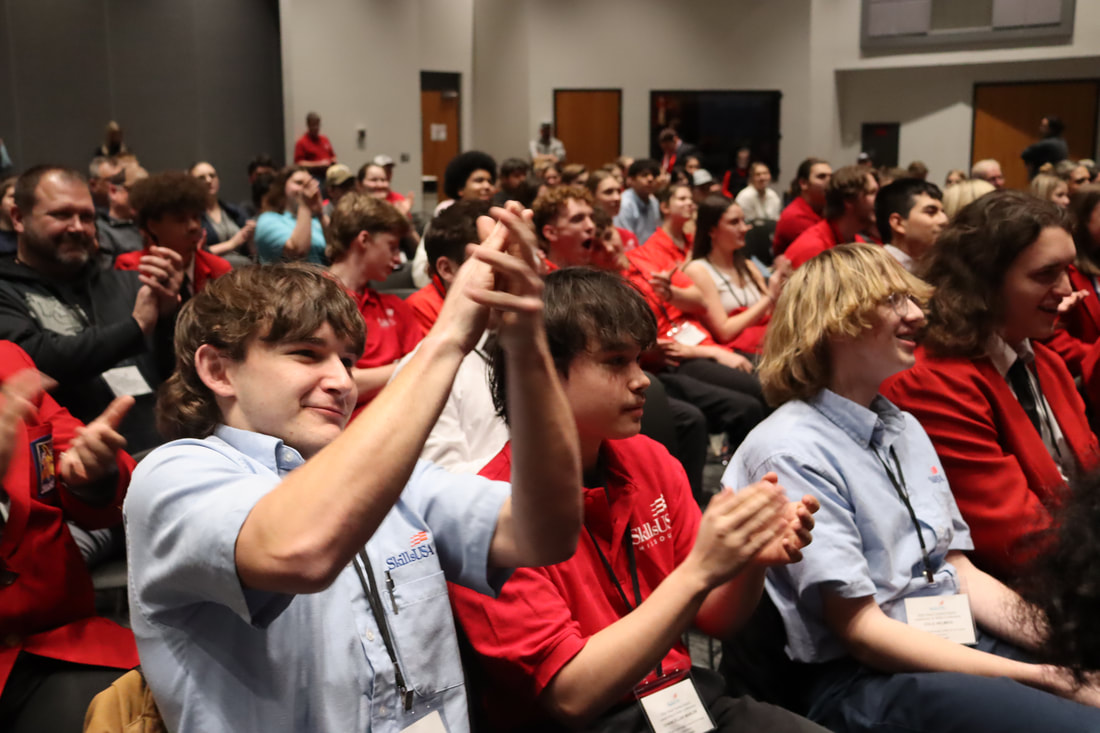 Foreground: CTC SkillsUSA Students. Photo courtesy CTC  GVHS Senior Chance Marler, second from right, advanced to State competition after competing in the SkillsUSA West Central District contest for Automotive Service Technology (CTC student Diego Gonzales-Aguilar is pictured next to Chancellor and took first place; both will advance to State). Photo courtesy CTC.  Missouri lawmakers want to raise teacher pay but anticipate Senate resistanceby Annelise Hanshaw, Missouri Independent Legislation boosting teacher recruitment and retention in Missouri is once again a priority of the Missouri House, with a hearing Wednesday morning on a pair of Republican-backed bills. Rep. Ed Lewis, a Republican from Moberly, is sponsoring legislation based on the findings of the State Department of Elementary and Secondary Education’s blue ribbon commission. It is the third year he has sponsored legislation on teacher recruitment and retention. “The problem is obvious to all of us at this point,” he told the committee. “We don’t have enough teachers for our public schools and, to some extent, for the private and parochial schools as well.” After three years in a Missouri school district, an average 43.3% of teachers leave, according to the Department of Elementary and Secondary Education. According to the Missouri National Education Association, a teachers’ union, the state ranks 50th in average starting teacher pay and 47th in average teacher pay. Lewis’s bill seeks to raise the base teacher pay, allow differentiated salary schedules for hard-to-staff areas and increase scholarships to recruit teachers, among other provisions.
Rep. Ann Kelley, a Republican from Lamar, asked whether support staff could be added to the bill. “The schools cannot be successful without the support staff, and the salaries of the support staff and retention and retaining those support staff is vital,” Kelley said. Lewis was hesitant to increase the potential fiscal impact. “We’re gonna have a hard time getting anything across the finish line on the other side,” he said, referring to the Senate. Last year, he filed the teacher pay-raise proposals as separate bills before the committee combined them into one bill. The House overwhelmingly approved the legislation on a 145-5 vote, but filibusters in the Senate ran out the clock before it could be debated in that chamber. Rep. Willard Haley, a Republican from Eldon, is also sponsoring a bill to raise teachers’ minimum salary — though his ask is a bit different. He hopes to raise the base to $46,000 by the 2027-28 school year. Fully implemented, the bill is estimated to cost up to $17.5 million. “I just insist that it’s time that we start paying our teachers what they deserve,” Haley said. He said teenagers with a high-school diploma can make more working at a local factory than some teachers do. Currently, state statute allows schools to pay teachers as little as $25,000 or $33,000 for those with a master’s degree and 10 years of experience. The state has a grant program, which is up for renewal annually, to raise teacher base salaries to $38,000. In the current school year, 310 school districts are using the grant for a total of 4,806 teachers, the Missouri Department of Elementary and Secondary Education told The Independent. Gov. Mike Parson has requested an increase to this program to raise the base to $40,000 for the next fiscal year. Lewis doesn’t like relying on the annual appropriations for teacher salaries. He said he worries, with an upcoming gubernatorial election, the next governor may not fully fund the base-salary grant. “I don’t think we should legislate through the budget. I think that the policy should go first and the budget should follow,” he told the committee. Haley’s bill prescribes a fund that would match district’s contributions 70/30 to get salaries to his preferred base. Rep. Kathy Steinhoff, a Columbia Democrat, said she wanted a “broader” change. “I look at our large school districts… 52% of our districts will see no impact from state dollars towards teacher salaries,” she said. “I feel pretty confident if we ask those districts ‘Are you having a retention problem?’ They would probably all say yes.” Rep. Dan Stacy, a Republican from Blue Springs, asked if a base-pay increase could be tied to a decrease to another part of the budget. Haley said his bill is “top priority.” “This is such a priority item that we must handle this,” he said. “We must fulfill this funding even at a cost to some other things. But education is that important to me.” No one testified in opposition to the legislation Wednesday. SUPPORT NEWS YOU TRUST.
DONATE
Perry Gorrell, interim legislative liaison for the Department of Elementary and Secondary Education, said raising the base teacher pay is the Commissioner of Education’s top priority. “We know that the greatest impact on student achievement is having highly qualified teachers for students. These two bills helped to ensure that,” he said. Otto Fajen, lobbyist for the Missouri branch of the National Education Association, said the teachers’ union would like lawmakers to consider small schools with under 100 kids when looking at funding. “While not that many of our members are going to benefit directly from the increase here, it sends a message that the legislature believes that entry pay and, overall, the earnings for teachers should resemble similar professions to make it a more viable choice going forward,” Fajen said. Steve Carroll, a lobbyist representing the Cooperating School Districts of Greater Kansas City and St. Louis Public Schools, said he woke up at nearly 4 a.m. thinking about these bills. He felt like his anxiety was pointless because the bills “probably won’t even make it across the finish line because of what’s going on in the Senate.” But he saw the salary of a baseball player in a news article and marveled at society’s “priorities.” He believes teachers are the ones more deserving of higher pay. GET THE MORNING HEADLINES DELIVERED TO YOUR INBOX
SUBSCRIBE
Missouri Independent is part of States Newsroom, a network of news bureaus supported by grants and a coalition of donors as a 501c(3) public charity. Missouri Independent maintains editorial independence. Contact Editor Jason Hancock for questions: info@missouriindependent.com. Follow Missouri Independent on Facebook and Twitter.
by Cole Arndorfer The Grain Valley Schools Board of Education met on Thursday, January 18, for their first meeting of 2024. Superintendent Dr. Brad Welle led off the meeting with his report for the month. In his report, Welle recognized the first-year participants of the leadership seminar. Welle and Dr. Allen also talked about various leadership initiatives taking place in both North and South Middle School. In wrapping up the report, Welle noted the construction and financial updates that were given to the board as part of his report. Addressing construction updates, assistant superintendent Dr. Nick Gooch told the board that the projects are still trending ahead of schedule with crews working on painting and various other tasks. Gooch reported that the district has been able to take some of the project’s contingency money and put it to other improvements around the district. So far, the district has been able to use some of the money to provide some additional storage outside of athletics and activities spaces at the high school. They are also looking into some asphalt replacements and improvements at the high school. The district is also awaiting findings from the safety audit to identify safety items that may need improvements within the schools. Under unfinished business, the board unanimously approved ballot language to be placed on the April 2024 ballot requesting a levy increase. The main focus with this tax levy issue, Welle explained, is on improving and providing competitive teacher pay. Welle said that the ballot language will include safeguards that would allow the district to use that money in the general fund in the case that state funding was reduced, but he does not see that happening. In an email to district parents and patrons, Welle addressed the levy issue. “Voters will be asked to raise the operating tax levy rate ceiling by $0.65. The district commits to reducing the debt service levy by $0.40, resulting in an estimated overall tax levy ceiling increase of $0.25. With the passage of this measure, the owner of a home with a market value of $250,000 would see an increase of $119 per year. The primary purpose of this ballot measure is for competitive pay, but some general operating expenses of the district including security are also expected to be impacted.” Under new business, the board discussed the timeline for the budget planning process for the 2024-2025 school year. After some discussion on that, the board discussed information about the 2024-2025 district calendar. Some priorities on the calendar, discussed by Gooch, would be to balance out the amount of time that students are in session across all district schools. According to Gooch, this would allow the district to add another professional development and teacher work day to the calendar, while still increasing the in-session hours for the district. Following new business, the board adjourned into executive session. The next Board of Education meeting will take place on February 22 at 6 pm in the Leadership Center. Good News: Sni-A-Bar students win 3rd place in the "Battle of the Brains" and receive $20,000 grant1/25/2024
Sni-A-Bar Elementary students were among hundreds of students who attended the "Battle of the Brains" awards ceremony on January 23rd, and the team placed third for their "Disasster Strikes" proposal, winning a $20,000 grant for the school. Earlier in the school year, they were named Top 20 out of 740 big idea submissions in the Kansas City area in Burns & McDonnell’s STEM competition. The 2023-24 competition included more than 6,800 students from 245 schools across 50 school districts throughout the Kansas City region. Judges — STEM professionals from Burns & McDonnell and Science City — followed an evaluation process to rank entries according to specific criteria, ranging from creativity and inspiration to how interactive and engaging the exhibit would be for visitors. “All of the students’ proposed exhibits were amazing — it was really hard to pick a winner,” George Guastello, president and CEO of Union Station said. “Battle of the Brains is an incredible program that has transformed Science City into a museum full of STEM activities for kids of all ages.” Delta Woods Middle School in Blue Springs won the competition with its ElectroMAGNIFICENT! entry. The Burns & McDonnell Battle of the Brains competition is one of the nation’s most unique K-12 STEM programs, with thousands of students competing to pitch their unique classroom idea for a permanent exhibit at Science City. Student participation has nearly tripled since the first competition in 2011. Burns & McDonnell has designed and built seven major exhibits that have transformed Science City, or more than half of the nearly 100,000 square feet of the science center’s interactive exhibit space.  Students from Sni-A-Bar Elementary School celebrated their third place win in the Battle of the Brains competition. The school was awarded a $20,000 grant in honor of the team's winning entry. Photo credit: Grain Valley Schools  FAFSA Delay Doesn't Dampen Donor Generosity: THCF Scholarship Application Deadline Extended1/18/2024
Truman Heartland Community Foundation (THCF) provides educational scholarships to a diverse group of students based on the specific criteria set in partnership with donors. Over the years, more than 184 generous donors have established scholarship funds at the foundation to help students pursue their educational goals. Since its inception in 1982, the foundation has awarded scholarships totaling more than $6.7 million. This year, the foundation is proud to make approximately $800K in scholarship funds available to students throughout the area. However, recent changes to the Free Application for Federal Student Aid (FAFSA) are causing problems and delays for students. If you plan to pursue higher education in the Fall, it is important to know about recent changes to the FAFSA, the US Department of Education’s form that gathers information about students’ financial situation to help determine their eligibility for federal financial aid. Many organizations and institutions, including THCF, use data from the FAFSA Submission Summary to evaluate the financial need of scholarship applicants. Changes to the FAFSA form for the 2024-2025 school year became available on December 31, 2023. Typically, the FAFSA is available in October each year, but due to the form change, the FAFSA was delayed. Additionally, there appears to be continuing issues with the online form, as students find the form is sometimes offline and unavailable. Because of this delay, THCF application timelines have been adjusted as well. The THCF General Application was available starting December 15, 2023, and will remain open until April 1, 2024. All essays, letters of recommendation, and other documents that may be required must be submitted by the deadline without exception. If you want to learn more about the FAFSA changes, visit www.mofafsa.org. THCF is committed to helping donors achieve their philanthropic goals and students achieve their academic goals. If you have questions about the FAFSA, need to know how to go about setting up a scholarship fund, or have problems during the application process, please visit the Truman Heartland Community Foundation website at www.thcf.org/students/scholarships or contact Rachael Watkins, Director of Scholarships at Truman Heartland Community Foundation, watkins@thcf.org. We are honored to help our fundholders create opportunities for students to pursue their dreams and to support them on their educational journeys. Open enrollment is the first education bill considered this year by Missouri Houseby Annelise Hanshaw, Missouri Independent A proposal to allow Missouri’s public school districts to open their boundaries is back this legislative session as the first education bill to get a hearing in the state House. The House Committee on Elementary and Secondary Education opened its first hearing of the year by considering Sedalia Republican Rep. Brad Pollitt’s open enrollment bill. “This bill allows the 899,000 students in the state of Missouri in the public school system the opportunity to have choice within the very system that their parents pay taxes to,” Pollitt told committee members. He told The Independent at the close of last year’s session that there was a plan in place to pass his bill through the Senate, latching it to state Rep. Ed Lewis’s bill on teacher recruitment and retention. But in a fit of filibusters in the session’s closing days, the bills never made it to the full Senate for debate. Pollitt wrote what he calls a “compromise” into the bill, capping the number of transfers annually at 1% of the student population in districts with a high number of free-and-reduced-lunch students. He thought this would help it pass the Senate, but he told the committee on Wednesday that policy leaders in the Republican caucus recommended removing the provision. Otto Fajen, lobbyist for the Missouri branch of the teachers union National Education Association, said removing the compromise language caused him to oppose the bill. Otherwise, the association would have a more neutral stance. “Because the committee is now poised to remove any protection against resegregation… you need to be thoughtful about that,” Fajen said. “You need to have some kind of break if you start to see things going in the wrong direction.”
Some lawmakers last year voiced concerns that the bill would resegregate schools if minority students stayed in their home districts while others left. Rep. Paula Brown, a Democrat from Hazelwood, repeated this concern Wednesday. “Do you worry that we could face another desegregation plan from the feds at all with any of this?” she asked. “I can’t look into a crystal ball and say that only non-minority students would leave the district,” Pollitt responded. The bill has a 3% limit on the proportion of students that can leave a school district annually. Some are worried the limit isn’t enough protection for school districts. Mike Lodewegen, lobbyist for the Missouri Council of School Administrators, said the students and teachers that are left in a district after some leave “have to deal with the ramifications.” The district will want to make cuts when the state funding leaves, he said, but the students leaving will likely be spread across grade levels. “Now you’re looking at cutting programs and options available to students,” Lodewegen said. When students enroll in a neighboring district, according to the bill, state aid — but not local aid — will follow them. It also calls for a $80 million fund to reimburse transportation costs for students that qualify as free and reduced lunch or enrolled in special education. Pollitt said the $80 million was based on the number of students he anticipates will participate in enrollment, looking at surrounding states’ open-enrollment programs. The number of special education students participating in this program may be stifled by a provision that says school districts are not required to add staff or programs if they opt into open enrollment. Rep. Kathy Steinhoff, a Columbia Democrat, asked if that would be akin to discrimination based on disability. Pollitt said he wrote this provision based on a case out of Wisconsin where a court ruled school districts didn’t have to add staff for its open-enrollment program. He asked superintendents during his travels around the state about this provision, inquiring whether it should be mandatory to accept students in special education. “Absolutely not,” he said he was told. “Because we know in this state that our special ed teachers have their case votes that are already full.“ The bill passed the House last session in a 85-69 vote. GET THE MORNING HEADLINES DELIVERED TO YOUR INBOX
SUBSCRIBE
Missouri Independent is part of States Newsroom, a network of news bureaus supported by grants and a coalition of donors as a 501c(3) public charity. Missouri Independent maintains editorial independence. Contact Editor Jason Hancock for questions: info@missouriindependent.com. Follow Missouri Independent on Facebook and Twitter.
Bolivar Technical College celebrated graduates on Saturday, December 16, 2023, including Allison Steward of Grain Valley. The RN to BSN Completion program at Bolivar Technical College consists of an online curriculum designed to take one year to complete. Once complete, graduates earn their Bachelor of Science in Nursing degree and pave the way for career advancement and additional patient care and education they can provide. The Class of 2023 BSN graduates include: Angela Amonett of Buffalo, Tiffany Bailey of Rogersville, Casey Keith of Dunnegan, Allison Steward of Grain Valley, Brianna West of Aldrich, Caitlyn Williams of Norman, OK, Jennifer Gary of Springfield, Charlene Hebeler of Lebanon, Tiffany Radford of Battlefield, and Brittany Slagle of Bolivar. Bolivar Technical College is a non-profit technical college serving southwest Missouri with a focus on education for students entering the healthcare industry. The college educates students through programs including online RN to BSN Completion, Professional Nursing (RN), Practical Nursing (LPN), RN Bridge (for LPNs and Paramedics) and CMT. |
Categories
All
Archives
April 2024
|

 RSS Feed
Grain Valley NewsGrain Valley News is a free community news source published weekly online. |
Contact Us |

|