
|
|
by Tamra Reall (@MUExtBugNGarden) is a horticulture specialist for MU Extension – Urban West Region (Article used with permission from the Kansas City Gardener.) Get ready for a magical cicada spectacle this spring! Billions of buzzing insects from periodical cicada Broods XIII (13) and XIX (19) are emerging in April and May. Last seen together in 1803, they won't appear together again for another 221 years. In Missouri, we will just be seeing Brood XIX, while Brood XIII will be mostly in northern Illinois. I hope you will join the excitement, enjoy the rhythmic buzz, and marvel at nature’s spectacular show! What is the difference between periodical cicadas and the cicadas that come out every year? Periodical cicadas are like nature's timekeepers, following a mysterious, prime number schedule that scientists are still learning about. Having the longest life cycle in the insect world, periodical cicadas seem to magically appear together every 13 or 17 years. This is why their genus name is Magicicada! They spend most of their lives underground as nymphs feeding on the sap of tree roots. Then, as if waiting for the perfect moment, groups of Magicicada species, called a “brood,” emerge together all at once. These small, black cicadas with red eyes appear in such large numbers that they can cover trees. These clumsy fliers are easily captured by birds, squirrels, raccoons, and even dogs and cats. With so many emerging at the same time, many will survive to lay eggs for the next generation emerging in another 13 or 17 years later. Another fascinating feature of these insects is that the males sing together to attract females. In contrast, the large, green cicadas we see each summer have a shorter life cycle of 2-5 years and are known as annual or dog-day cicadas as some become adults every year. While these cicadas also sing in the trees, they give solo performances and do not synchronize like the periodical cicadas. Are periodical cicadas everywhere in the world? Although annual cicadas are found on every continent except Antarctica, periodical cicadas are only found in the eastern half of North America. Scientists do not know why they aren’t found anywhere else. There are four species of periodical cicadas in Brood XIX and these will emerge in Missouri, Indiana, Illinois, Kentucky, Maryland, Virginia, North Carolina, South Carolina, Arkansas, Oklahoma, Tennessee, Alabama, Georgia, Louisiana, and Mississippi. In Brood XIII, there are three species, and they are emerging in Illinois, Iowa, Indiana, Wisconsin, and possibly Michigan. Brood XIX, also known as the Great Southern Brood, emerges every 13 years, and Brood XIII (the Northern Illinois Brood) emerges every 17 years. 17-year broods tend to be in the northern states with cooler temperature zones, and 13-year broods tend to be in the warmer, southern states although there is a lot of overlap between 13- and 17-year broods. Why do cicadas shed their skin? Cicadas shed their skin to grow bigger. Like other insects, they have a hard outer covering called an exoskeleton. As they grow, their old exoskeleton becomes too small, so they shed it in a process called molting leaving behind old exuviae and growing new, larger exoskeletons. Do periodical cicadas hurt people, animals, or plants? Cicadas may land on people, but they won’t eat you – you don’t taste, feel, or smell right to them. That said, if one lands on you, gently brush it off, just in case the cicada is curious about what you might taste like! But, the cicadas can affect trees. Females lay their eggs in small twigs in trees. Large healthy trees aren’t harmed in the long term by this, although there may be dead twigs that fall after the cicadas are gone. Smaller trees can be damaged or even killed if not protected. Consider covering small, or newly planted, trees with a fine mesh material or cheesecloth to protect them during the 4-6 weeks the cicadas are out. Why do they make that loud sound? Males use a drum-like structure on their abdomen called tymbals to sing their loud, repetitive buzzing song, attracting female companions. A female will fly to the males and respond by quickly flicking her wings together if she likes his song. Periodical cicadas can be tricked by other vibrating sounds. They may be attracted to people mowing their lawns or using power tools. Periodical cicadas are loud! Because the males sing together, the buzzing sound can reach up to 100 decibels, which is as loud as a hair dryer, lawn mower, or a motorcycle. Consider wearing hearing protection if you will be outside for more than 15 minutes when the cicadas are singing to protect your hearing. What happens to cicadas after they mate and lay eggs? After mating, female cicadas lay their eggs in the branches of trees. They use a sharp ovipositor to make tiny slits in the bark, where they deposit their eggs. Males die soon after mating and females die after laying their eggs. A couple of weeks later, the eggs hatch and young cicada nymphs fall to the ground and burrow into the soil where they'll spend the next 13 or 17 years before starting the cycle all over again! ~~~~ Did you know that there is a Kids Ask Dr. Bug video series? Check it out! https://bit.ly/KADBvideos Do you have questions for Dr. Bug? Send them to https://bit.ly/KidsAskDrBug To help me learn what you learn from this column, or to share feedback, please consider filling out this survey: https://bit.ly/KidsAskDrBugSurvey 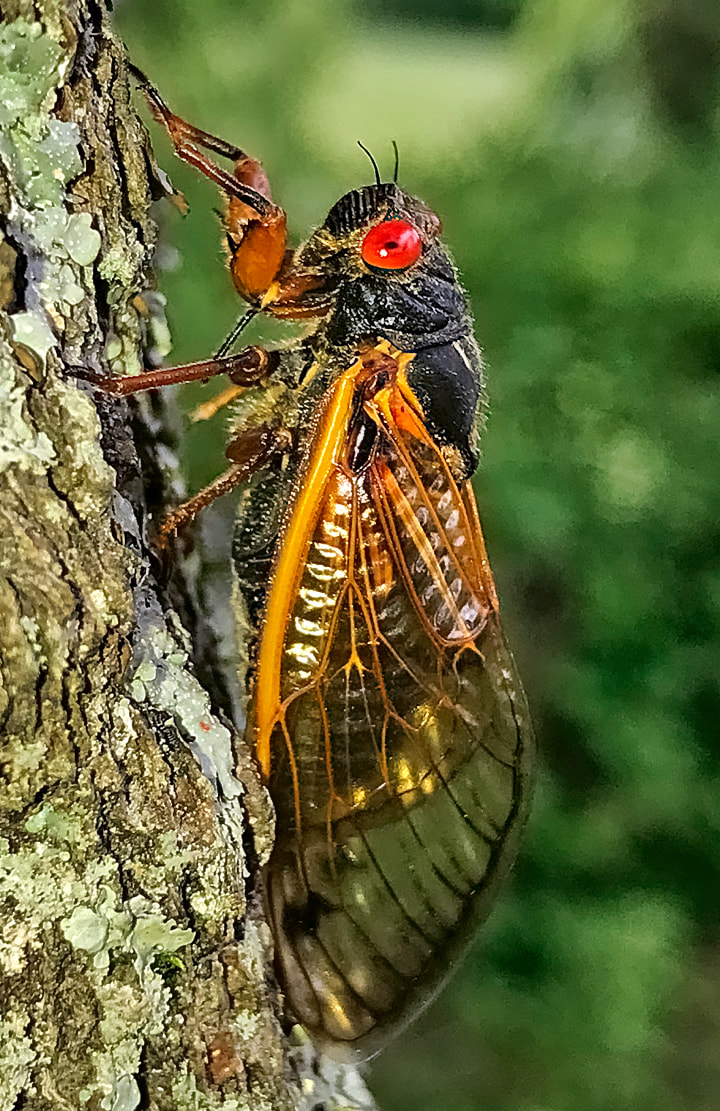 Known for their red eyes, cicada eyes actually can be several colors. Photo courtesy of Gene Kritsky, Mount St. Joseph University  Comments are closed.
|
Categories
All
Archives
April 2024
|
 RSS Feed
Grain Valley NewsGrain Valley News is a free community news source published weekly online. |
Contact Us |

|